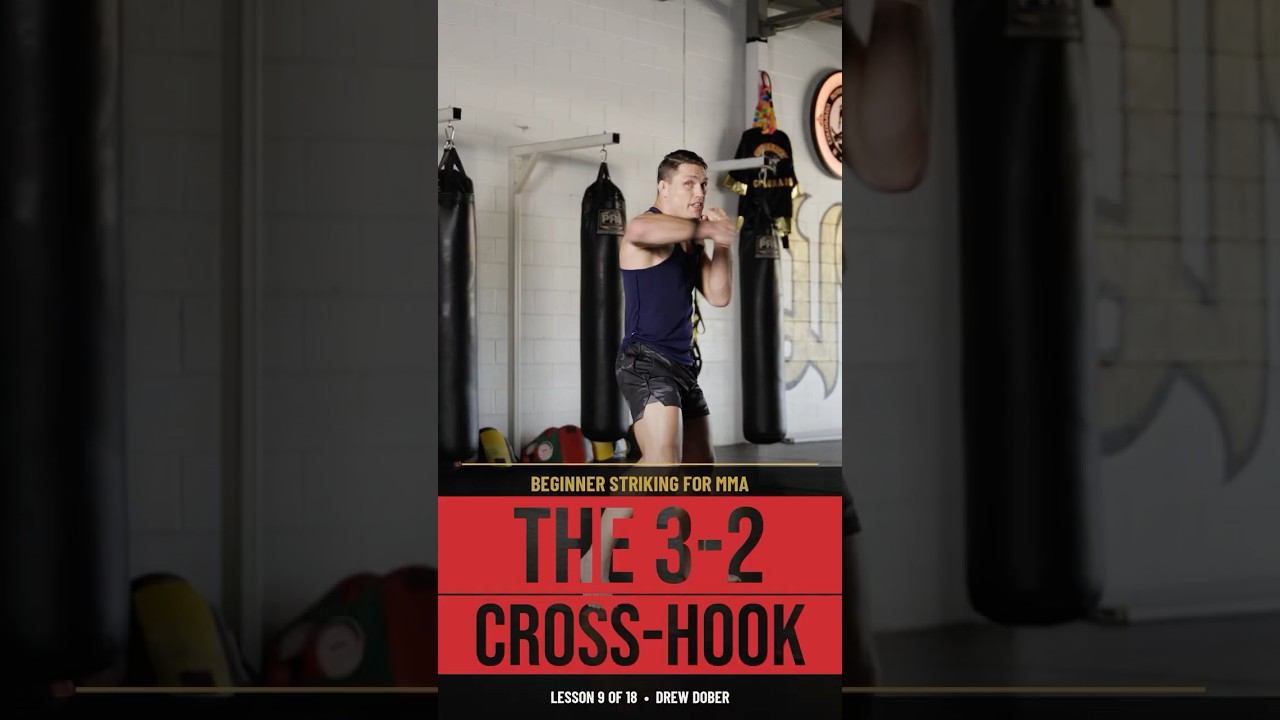
Drew Dober breaks down his favorite MMA combination: the cross hook and hook cross. Learn the mechanics, footwork, and rotation that make these power combinations fight-enders.
Key Takeaways
The cross hook and hook cross are my favorite combination. I have said that before and I will keep saying it, because it is true. These are power-generating combinations. When you land either version cleanly, people go down. Here is how to throw them right.
The hook cross and cross hook are not how you open a fight. They come after you have established your movement, your range, and started touching your opponent. Earlier in this series, we covered the jab and the 1-2 as range-finding tools. The cross hook is what you reach for once your opponent is already in your range and you have earned the position to throw something heavy.
Think of it in sequence. You use your jab to find the target and disrupt. You use the one-two to start applying pressure. Now you are inside range, your opponent is reacting, and that is when you put in the finishing combination.
I am left-handed, so my left hand stays in back. If you are right-handed, your right hand and right leg stay in the back. Your dominant hand is your rear hand, and your rear hand is your power hand. That is the cross in this combination.
Get into your fighting stance and settle into it before you throw anything. The combination starts from a balanced, grounded position.
The hook is the first punch in the hook-cross, or the second in the cross-hook. Either way, the mechanics are the same.
As you step into the punch, your elbow comes out to roughly shoulder height. Your knuckles are positioned at the target. Your thumb points up. That upward thumb position is what generates the power for a hook. It is different from the cross, where the thumb rotates down on extension. For the hook, keep the thumb up and let the elbow do the work.
The power in the hook comes from rotation starting at the floor. You twist your foot, your knee, your hip, and your shoulder in sequence. That full-body twist is what carries force into the punch. When you see someone get folded by a hook, it is because the punch carried the rotation of an entire body, not just an arm.
That rotation also sets something up: as your lead side twists through the hook, your rear side loads. The cross is cocked and ready to fire the moment the hook releases.
After the hook lands, pull it straight back to your face. Do not let it hang. The moment it is back in position, unscrew the cross.
Full extension on the cross. Thumb pointing down, knuckles aimed at the target, twist at the hip level. The elbow stays in tight. Sometimes mine comes out a little, but the idea is to make sure you are twisting through the punch and not just shoving your arm forward. The power lives in the hip rotation, not the shoulder.
Your lead hand returning to your face and your rear hand firing the cross can almost happen simultaneously when the timing is right. The pull and the fire are coordinated, not sequential.
The cross hook runs the same mechanics in reverse. You extend the cross first, twist through it, and as the cross comes back to your face, you position your lead hand into the hook. Then you rotate your body to generate the hook’s power.
The floor-to-shoulder twist is the same in both versions. Twist the foot, twist the knee, twist the hip, and let the shoulder carry the punch. Twisting with your punches without losing your balance is the core skill here. Everything you built with the hook applies directly here.
I want to be specific about this because it is how knockouts happen.
When you throw from your feet up through your body, you are generating rotational force through a chain of joints. Each link in that chain adds to the final output. A punch thrown with just the arm delivers arm power. A punch thrown with the full rotation delivers body power, and body power is what drops people.
The cross hook and hook cross are designed to deliver two of those full-rotation punches in quick succession. The first punch sets the position and loads the second. The second lands on an opponent who is reacting to the first. That timing is what makes the combination so dangerous.
Step as you punch. Do not stand still and throw the combination. The footwork and the punch happen together, and that step is part of what generates the force.
Shadow the combination first. Get the feel of the rotation before you add resistance. Then bring it to the heavy bag and pay attention to whether both punches are landing with full extension and hip drive or whether one of them is a half punch. Both shots need to be real.
When you can throw the cross hook and hook cross with balance and full rotation, you have a finishing combination. That is how I knock people out, and it can be a weapon for you too.
To learn more and get first access to my knockout instructional series, go to Drew Dober and sign up for the newsletter.
When should you throw the cross hook in a fight?
After you have established your movement, your range, and started touching your opponent. Use the jab and the 1-2 first to find the range and apply pressure. The cross hook is what you reach for once your opponent is already in your range and reacting.
How is the hook different from the cross mechanically?
For the hook, your thumb points up and your elbow rises to about shoulder height with your knuckles aimed at the target. For the cross, the thumb rotates down at full extension. The hook generates power through rotation starting at the floor, not by driving straight into the target.
Why does the first punch in the combination load the second?
As your lead side twists through the hook, your rear side loads automatically. The cross is cocked and ready to fire the moment the hook releases. The rotation of the body in one direction stores energy for the next punch in the other direction.
What is the difference between the hook cross and the cross hook?
The order. Hook cross leads with the hook, then follows with the cross. Cross hook leads with the cross and finishes with the hook. The mechanics of each punch are identical in both versions. Only the sequence changes.
What does twisting from the floor actually do?
When you throw from your feet up through your body, you generate rotational force through a chain of joints. Each link adds to the final output. A punch thrown with the arm delivers arm power. A punch thrown with full rotation delivers body power, and body power is what drops people.
Drew Dober · Inner Circle