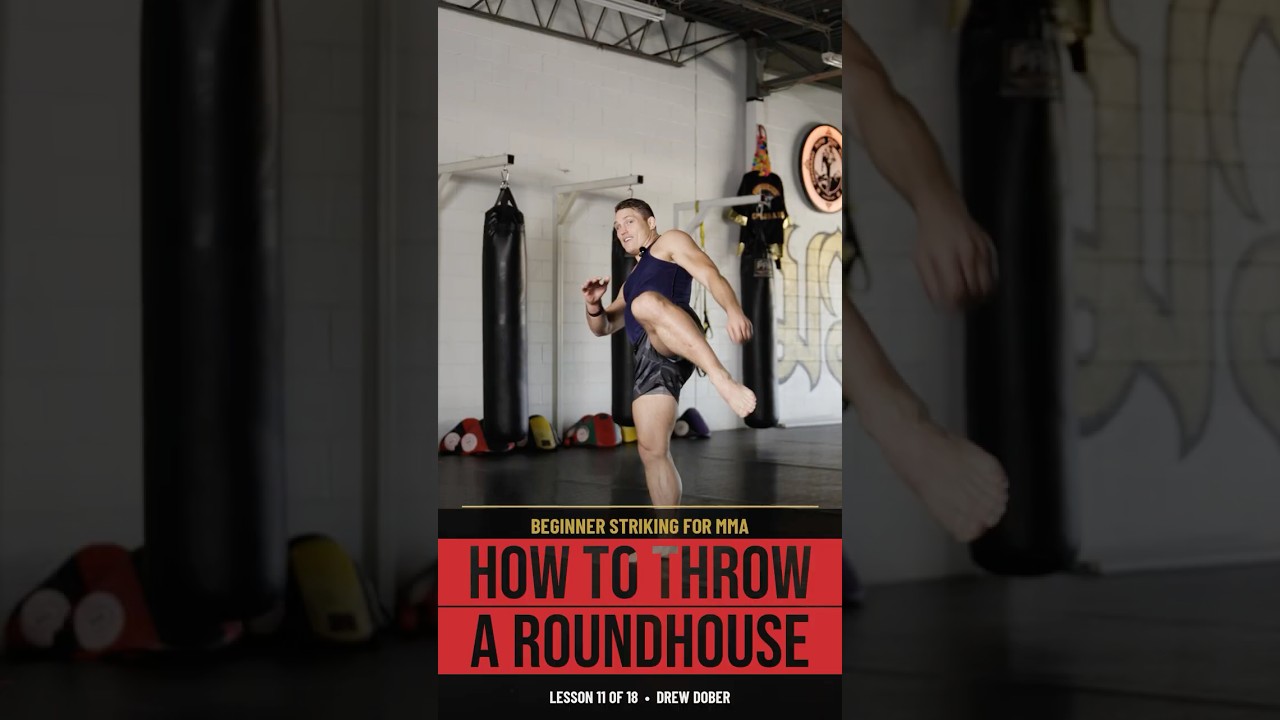
UFC knockout artist and Muay Thai expert Drew Dober breaks down the roundhouse kick for MMA: stance, chamber, hip rotation, and how to throw it to the body or head.
Key Takeaways
The roundhouse kick is one of the most powerful weapons in MMA striking. Done right, it can drop a body shot or take someone’s head off. The mechanics are specific, and if you get them wrong you will not generate power and you may break your foot in the process. Here is exactly how to throw it.
Your stance determines which leg you kick with. I am left-legged, so my left leg stays in the back. That is my primary kicking leg. The same logic applies as with your hands: your dominant side stays in the rear position, and your rear leg is your power leg.
Whatever your fighting stance is, your primary kicking leg should be in the back. Get comfortable generating kicks from that rear position. That is where your power lives. If your stance and footwork are not already locked in, build that foundation before adding the roundhouse.
The roundhouse kick does not generate power the way a punch does. You are not driving into the target. You are opening your hip and rotating in a circle. Your opponent is the only thing stopping that momentum, and that is what causes the damage.
Think of your leg as a bat being swung around your body. The bat gets heavier the faster the rotation. Your opponent catches that rotation with their body or head. When the technique is right, the force is significant.
I have a beautiful scar on my shin that shows exactly what we hit with: the bottom part of the shin.
You never want to hit with your foot. Feet break. When fighters start throwing roundhouse kicks without proper technique, the foot makes contact first, and feet are not built to absorb that kind of force against a hard target like a knee or an elbow. The shin is. The lower third of the shin is a dense, thick bone and it is your striking surface on this kick. Point your toes down as the kick extends to ensure the shin makes contact, not the foot.
Before the kick goes anywhere, you shift your weight off the leg you are throwing with.
If I am kicking with my left leg, I shift my weight forward to my right leg as I pick up my left knee. That lifting of the knee is what we call the chamber. The chamber is not just a preparatory position. It is the control point of the kick.
From the chamber, you can:
Your opponent does not know which of those options you are choosing. That uncertainty is what makes the chamber valuable beyond just being the setup for the kick. A fighter who has learned to read your kicks will struggle when you start mixing the real kick with the fake from the same chamber position.
After the chamber, you aim your knee at the target. The knee points the way, just like in the leg kick. For a body kick, you want to aim for the liver. Avoid the elbow - catching a hard shin against a planted elbow hurts you as much as it hurts them.
The power comes from throwing your hip over. The way you do that is by shifting your toes forward to your heel forward on the balance foot. That foot rotation is what allows the hip to drive through. Once the heel comes forward and the toes pivot back, the hip can follow completely through the kick.
I drill this in a simple rhythm: knee up, toes forward, knee down, heel forward. Play with that motion. Get comfortable with the hip opening and closing through each rep. When the hip drives fully through the kick, the force is completely different from a kick thrown with the hip held back.
The full sequence: shift your weight off the kicking leg, pick up the knee into the chamber, aim the knee at your target, throw the hip over by pivoting from toes to heel, extend the shin to the target at the last second. The hip drive pushes your opponent off balance or causes damage. Both outcomes set up what comes next.
Keep the shin as the contact point throughout. Do not reach with your foot to get to the target.
Everything above applies to the head kick. The only thing that changes is where the knee points in the chamber.
For the head kick, chamber the knee toward your opponent’s head instead of their body. When the hip throws over and you extend the shin, the kick goes to the ear, not the ribs. The rotation mechanics are identical. The target changes, and with it the angle of the knee in the chamber.
Training partners will tell you when your head kick is close. The goal is to extend the shin to the ear.
Do not add the roundhouse to your sparring before you have the mechanics. Shadow the chamber first. Practice the weight shift, the knee pick-up, the pivot, and the hip throw as separate components until the sequence feels natural. Then connect them.
On the heavy bag, start slow. Make sure the shin is making contact and that the hip is driving through on every repetition. A roundhouse kick that arrives on the hip is a score. A roundhouse kick that arrives with the full rotation of the body behind it is a finish.
To learn more and get first access to my knockout instructional series, go to Drew Dober and sign up for the newsletter.
Which leg do you throw the roundhouse with?
Your dominant leg stays in the rear, and your rear leg is your power kicking leg. I am left-legged, so my left leg stays in the back. Whatever your fighting stance is, your primary kicking leg should be in the rear position.
How does the roundhouse generate power differently from a punch?
You are not driving into the target. You are opening your hip and rotating in a circle. Your opponent is the only thing stopping that momentum, and that is what causes the damage. Think of your leg as a bat being swung around your body.
Why is the chamber so important?
The chamber is the control point of the kick. From that position you can kick to the body, kick to the head, or put your foot back down and fake it entirely. Your opponent does not know which option you are choosing. That uncertainty is what makes the chamber valuable beyond just being setup for the kick.
What part of the leg makes contact in a roundhouse?
The lower part of the shin. You never want to make contact with your foot. Feet break when they hit hard targets like a knee or elbow. The shin is dense and built to absorb that force. Point your toes down as the kick extends to make sure the shin connects and not the foot.
How does the balance foot create hip drive?
You pivot from toes to heel on the balance foot. Shifting from toes forward to heel forward is what allows the hip to follow completely through the kick. When the heel comes forward and the toes pivot back, the hip can open fully. That is where the roundhouse gets its real power.
Drew Dober · Inner Circle