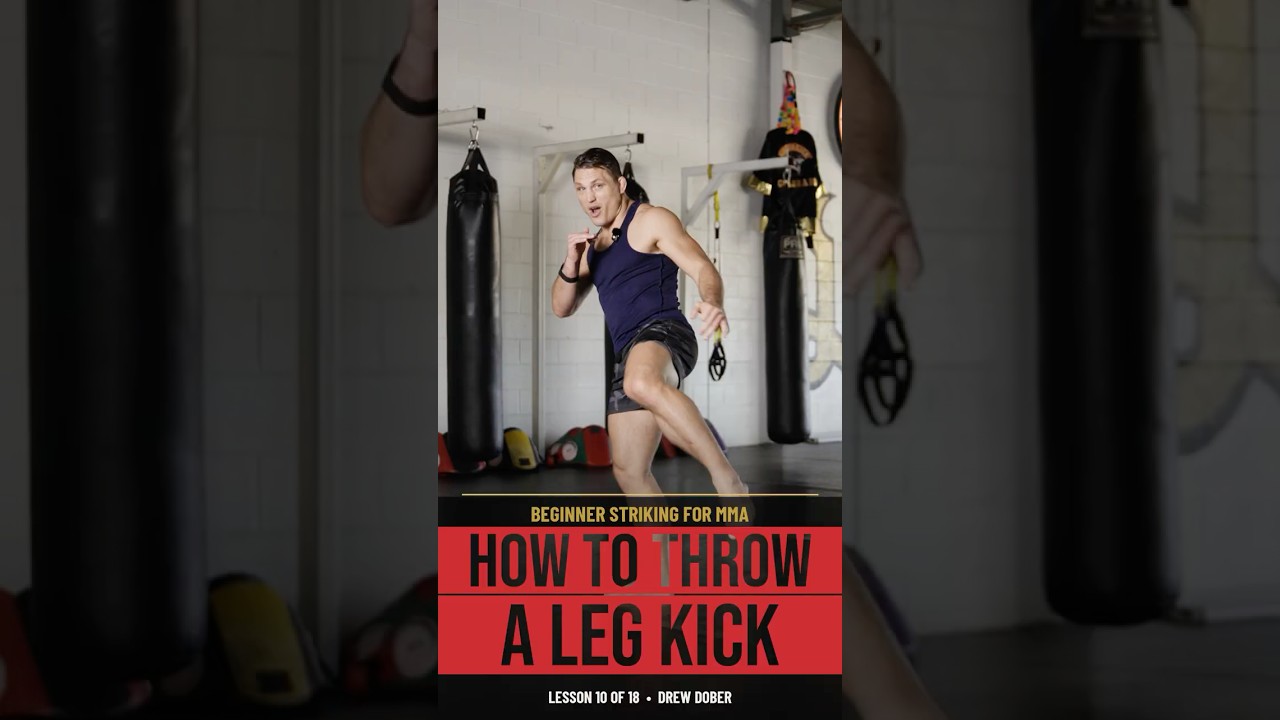
UFC lightweight Drew Dober breaks down how to throw a leg kick for MMA: stance, target selection, the X contact point, and the hip mechanics that generate real power.
Key Takeaways
The leg kick is one of the most effective weapons in MMA. Land it right and you are not just scoring points. You are repositioning your opponent’s base, taking away their ability to generate power from that side, and setting up everything else you want to do. Here is exactly how I throw it.
Before anything else, you need the right base. In Muay Thai, we want our toes pointed forward. We want balance on both legs, and we want to be able to pick up our legs in a rhythm without losing that balance. If you cannot lift either leg fluidly from your stance, you are already behind before the first kick goes.
This is not a minor setup detail. The stance determines everything that follows. If your weight is committed too far to one side, or your feet are too narrow, you lose the ability to shift weight cleanly before the kick. Get comfortable here first. The rhythm of picking up your legs should feel natural before you try to throw anything with power. If your stance and footwork fundamentals are not solid yet, build those before adding the leg kick.
Before you attack, establish which leg is in front. That depends on your opponent’s stance. If they are left-handed (southpaw), their right leg will be in front. If they are right-handed (orthodox), it will be their left leg. Most of the time, you are going after the lead leg. It carries more of their weight, it is the closer target, and landing on it disrupts their entire structure.
Knowing which leg to attack is not something you figure out mid-kick. You read it in the first exchange, and then you are already planning your entry.
Legs are generally pointed outward in a fighting stance. Because of that, the angle of your kick needs to match where you want to land. I think about the contact point as an X.
If you want to attack the inside of the leg, kick up slightly. If you want the outside of the leg, kick down slightly. The direction changes the effect. Hitting the outside of the thigh from a slightly downward angle knocks the leg outward and removes their base. Hitting the inside from a slightly upward angle produces a different off-balancing effect. In both cases, the goal is the same: reposition their leg and off-balance them so they cannot counter cleanly.
This is where most people get it wrong. They swing the leg. That is not a kick.
Before the kick goes, shift your weight away from the leg you are kicking with. If I am kicking with my rear leg, I shift my weight forward to release that weight off the back leg so I can throw it straight out. You cannot generate power from a leg that is still carrying your bodyweight. The shift comes first, and everything else follows from it.
Once the weight shifts, I aim with my knee. I point my knee at the target first. For an outside attack, I point my knee at the side of their thigh. Aiming with the knee is what gives you accuracy. You are steering the kick before it extends. If your knee is pointed at the wrong spot, the kick ends up in the wrong spot, regardless of how much hip you put into it.
After the knee points, the hip drives forward. The way that happens is through your balance leg. You rotate the balance foot by pointing your heel toward your opponent. That rotation is what allows the hip to follow through. When you see fighters spin after a kick, that is the result of a full hip rotation. The heel pivot is what makes it possible.
The sequence: shift weight, point knee at target, rotate hip forward, point heel of balance foot at your opponent.
At the last second, extend the leg and make contact with your shin, not your foot. The shin is the weapon. Your foot is the end of the lever. Shin contact concentrates the force and does real damage. Foot contact is softer and easier to absorb.
Put it together and it goes like this: shift the weight forward, aim with the knee, pivot around the balance foot while pushing the hip forward, then extend the kick at the last second. The goal when it lands is to knock the leg off balance or damage it. Either outcome sets up what comes next.
Slow this motion down in shadow work before you add speed. The weight shift, the knee aim, the hip rotation, and the shin extension need to feel like one movement. That takes repetitions, not just awareness of the steps.
A clean leg kick takes something away from your opponent every time it lands. Their balance shifts. Their movement gets shorter. By the time you have landed several to the same leg, they are managing damage instead of fighting freely. That changes what you can do with your hands, and it changes how much they trust their base when you pressure them.
Once you have the leg kick working, pairing it with the roundhouse kick gives you two different kicking weapons that set each other up and keep your opponent guessing at which height the next kick is coming.
The leg kick is not a flashy technique. It is structural work. Start it early in the fight, keep landing it, and watch how it opens everything else.
To learn more and get first access to my knockout instructional series, go to Drew Dober and sign up for the newsletter.
Which leg do you target with a leg kick?
Most of the time, you go after the lead leg. It carries more of their weight, it is the closer target, and landing on it disrupts their entire structure. Which leg is in front depends on their stance: southpaw puts their right leg forward, orthodox puts their left leg forward.
What is the X contact point Drew describes?
Legs are pointed outward in a fighting stance. Because of that, you need to match the angle of your kick to where you want to land. Kick up slightly to attack the inside of the leg. Kick down slightly to attack the outside. Each angle produces a different off-balancing effect.
Why do you shift your weight before the kick?
You cannot generate power from a leg that is still carrying your bodyweight. You shift your weight off the kicking leg first so you can throw it freely. The shift comes before everything else and the power sequence follows from it.
What does aiming with the knee mean?
Once your weight shifts, you point your knee at the target before the kick extends. Aiming with the knee gives you accuracy. If your knee is pointed at the wrong spot, the kick ends up in the wrong spot regardless of how much hip you put into it.
How does hip rotation work in the leg kick?
After the knee points at the target, you rotate your balance foot by pointing your heel toward your opponent. That heel pivot is what allows the hip to follow through. When you see fighters spin after a kick, that is the result of a full hip rotation coming from that heel pivot.
Drew Dober · Inner Circle