Body shots in MMA are harder to land than in boxing, but when you know how to hide them, they change the entire fight. Drew Dober breaks down the mechanics.
Key Takeaways
Most fighters go straight to the head. That’s what your opponent expects, that’s what they’re watching for, and that’s what they’re prepared to deal with. The body is right there the whole time, and most beginners never touch it.
A well-timed body shot doesn’t just hurt. It drops hands, slows movement, and opens up everything upstairs. Knowing how to throw body shots for MMA is one of the fastest ways to change what your opponent has to think about inside the cage. This is Lesson 7 of my Beginner Striking for MMA series, and we’re getting into the mechanics of going downstairs.
In boxing, fighters are working at a closer range. The distance from your fist to your opponent’s ribs is shorter, and you’re already in position to dig to the body without covering a lot of ground first.
In MMA, that range is longer. Fighters stand further apart to manage the threat of takedowns and kicks. That extra distance means you can’t just drop your level and fire to the body the same way a boxer does. You have to earn that position, and earning it means using your footwork and head movement before the punch ever gets thrown.
This is the part most people skip. They know the punch exists, but they don’t know how to get there safely. If you just lunge at the body without setting it up, you’re going to eat a knee or a kick on the way in. That’s not a body shot. That’s a bad decision.
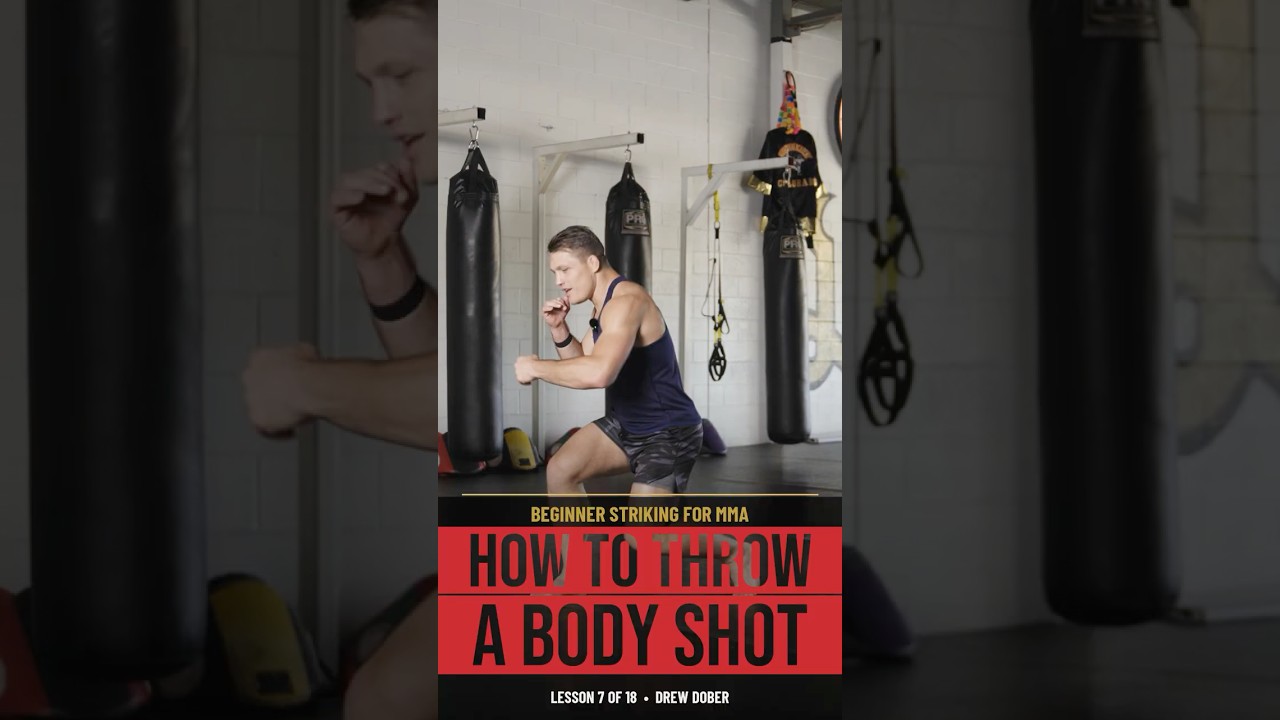
The straight punch to the body, whether it’s your jab or your cross, starts with one thing: a level change at your knees, not at your head.
When I want to attack the body with a straight punch, I bend at my knees and change the level from which I’m throwing. The punch itself comes straight out from my face, the same as it always does. What changes is where my face is. When I drop my level correctly, my face should be looking at my opponent’s belly button, his core, his vitals.
What I’m not doing is bending forward at the waist or dropping my head down first. If I lead with my head on the way to the body, I’m setting myself up to get kneed in the face or kicked in the face. That’s MMA. Those threats are always there. So the level change has to happen at the knees. Hips drop, knees bend, posture stays upright, and then the punch fires straight out.
The mechanics look like this: standing in your fighting stance, initiate the level change by bending your knees, let your hips drop, keep your eyes up, and throw your straight punch to the body from that lowered position. The punch path doesn’t change. Your body position does.
Practice the level change on its own before you add the punch. If it feels awkward or you’re catching yourself leaning forward, slow down and build the movement from the ground up.
Hooks and uppercuts to the body need a closer range than straight punches. These are tight, compact punches. If you’re too far away, they have no power and leave you reaching, which is a bad place to be.
To get close enough to land a hook or uppercut to the body, you need to use your footwork to close the distance and your head movement to do it safely. In MMA, you can’t just walk forward in a straight line and expect to get in range without catching something on the way in.
The way I set these up is by stepping forward with a head movement, slipping to one side to get off the center line, and then lowering my level at the knees as I come into range. From there, I can rip a hook to the body or dig an uppercut into the ribs.
The level change is still at the knees, not the head. Same principle as the straight punch. Always.
On the lead side, I bend at my knees, hook to the body. On the rear side, same thing: level change at the knees, uppercut to the body. Tight, controlled, thrown from a position where I’ve already closed the range and moved my head off the line.
Here’s what all of this comes back to. The body shot itself isn’t complicated. Bend at the knees, keep your posture, throw the punch. The hard part is getting there without telegraphing it.
Boxers can go to the body more readily because they’re already in close. MMA fighters have to cover more distance, which means every time you go to the body, you’re moving toward your opponent and making yourself a target in transit. That window, the moment you’re closing distance and changing levels, is when you’re most exposed.
The way you close that window is head movement and footwork. Don’t move in a straight line. Show a slip or a level change before the punch. Step at an angle. Use your motion to disguise where you’re going. Your opponent should read “head movement” and react to that before they realize the punch is headed for their ribs.
When you put it together, it’s not a single punch. It’s a sequence: close the range, move your head, change your level at the knees, and then rip the body. Each piece sets up the next. None of it works if you skip straight to the punch.
Start with the level change in isolation. Stand in your stance, bend at the knees, check that your posture is upright, and come back up. Do that until it’s automatic.
Then add the punch. Straight punch out from your face while your level is lowered. Don’t rush back up after. Stay down for a beat, keep your guard up, and then return to stance.
After that, work the footwork entry. Step in, slip, level change, punch. Get your partner to hold a body shield so you can feel the contact and get comfortable throwing in close range.
Once those pieces are solid, start combining. Jab to the head to set up the body. Feint the body to open up the head. Use both levels to keep your opponent from settling. That’s when body shots go from a technique to a real weapon inside the cage.
Drew Dober holds the all-time UFC Lightweight KO/TKO record with 11 finishes. This is Lesson 7 of 18 in his Beginner Striking for MMA series.
Why are body shots harder to land in MMA than in boxing?
MMA fighters stand farther apart to manage the threat of takedowns and kicks. That extra distance means you can't just drop your level and fire to the body the way a boxer does. You have to earn the position first using footwork and head movement.
How do you change levels safely for a body shot in MMA?
Bend at the knees, not at the waist. Your posture stays upright. Your eyes stay up. If you lead with your head on the way down, you're setting yourself up to get kneed or kicked in the face. Hips drop, knees bend, then the punch fires from that lowered position.
How do you set up a hook or uppercut to the body?
You need to be at close range first. Step forward with a head movement, slip to get off the center line, and then lower your level at the knees as you come into range. From there, rip a hook or dig an uppercut into the ribs. If you try to throw these from too far out, you're just reaching and leaving yourself open.
How do you hide a body shot so your opponent doesn't see it coming?
Use head movement and footwork on the way in. Show a slip or a level change that reads like head movement, step at an angle, and use that motion to disguise where you're going. Your opponent should react to what looks like a head movement before they realize the punch is headed for their ribs.
How do body shots fit into combinations?
They work both ways. Jab to the head to set up the body shot. Or feint the body to open up the head. Once your opponent has to defend two levels, they can't commit fully to either one. That's when both attacks start landing.
Drew Dober · Inner Circle